Filesystem is All You Need: Why Simple Agent Memory Beats Complex Vector Databases
How filesystem-based memory outperforms vector databases for AI agents, with production patterns from Claude Code and LangChain DeepAgents.
Filesystem is All You Need: Why Simple Agent Memory Beats Complex Vector Databases
Your AI agent's memory doesn't need a vector database. In fact, the filesystem might work better.
The Problem with Vector-First Thinking
When teams build AI agents, the default architecture looks something like this: agent generates content, embed it, store in Pinecone/Weaviate/Chroma, retrieve via semantic search. It's the pattern every tutorial teaches.
But there's a fundamental mismatch. Vector search optimizes for semantic similarity—finding things that mean something similar. Agents often need something different: finding exact content, maintaining document structure, or searching their own past work with precision.
As IBM's research team puts it: vector search "might not capture the specific context, structure, or relationships that are relevant for a particular task." When your agent needs to find a specific clause in a contract or update a particular line in a configuration file, semantic similarity isn't what you want.
Pure vector databases also come with operational overhead: no guarantees on reads and writes, limited ingestion throughput, and availability often below 99.9%. For production systems handling admin workflows, these aren't acceptable tradeoffs.
What Claude Code Taught Us
The insight came from watching how Anthropic built Claude Code. Their key design principle: "Claude needs the same tools that programmers use every day."
By giving Claude access to the filesystem via terminal commands—read, write, grep, glob—they created an agent that operates like a programmer does. No special APIs. No vector embeddings. Just files and standard Unix tools.
The results speak for themselves. Anthropic reports that filesystem isolation reduced permission prompts by 84%. More importantly, this approach "has also made Claude in Claude Code effective at non-coding tasks." The same pattern that works for code works for documents, configurations, and structured data.
Benchmarks Don't Lie
Letta's recent benchmark on AI agent memory tested this directly. A simple filesystem-based agent achieved 74.0% on the LoCoMo benchmark. Mem0's graph-based variant? 68.5%.
The explanation is surprisingly simple: "Agents are extremely effective at using filesystem tools, largely due to post-training optimization for agentic coding tasks."
Modern LLMs have been trained extensively on coding tasks. They already know how to use file tools effectively. Read, write, grep, glob—these aren't exotic APIs. They're the same tools programmers use daily, and the model already understands them deeply.
The DeepAgents Architecture
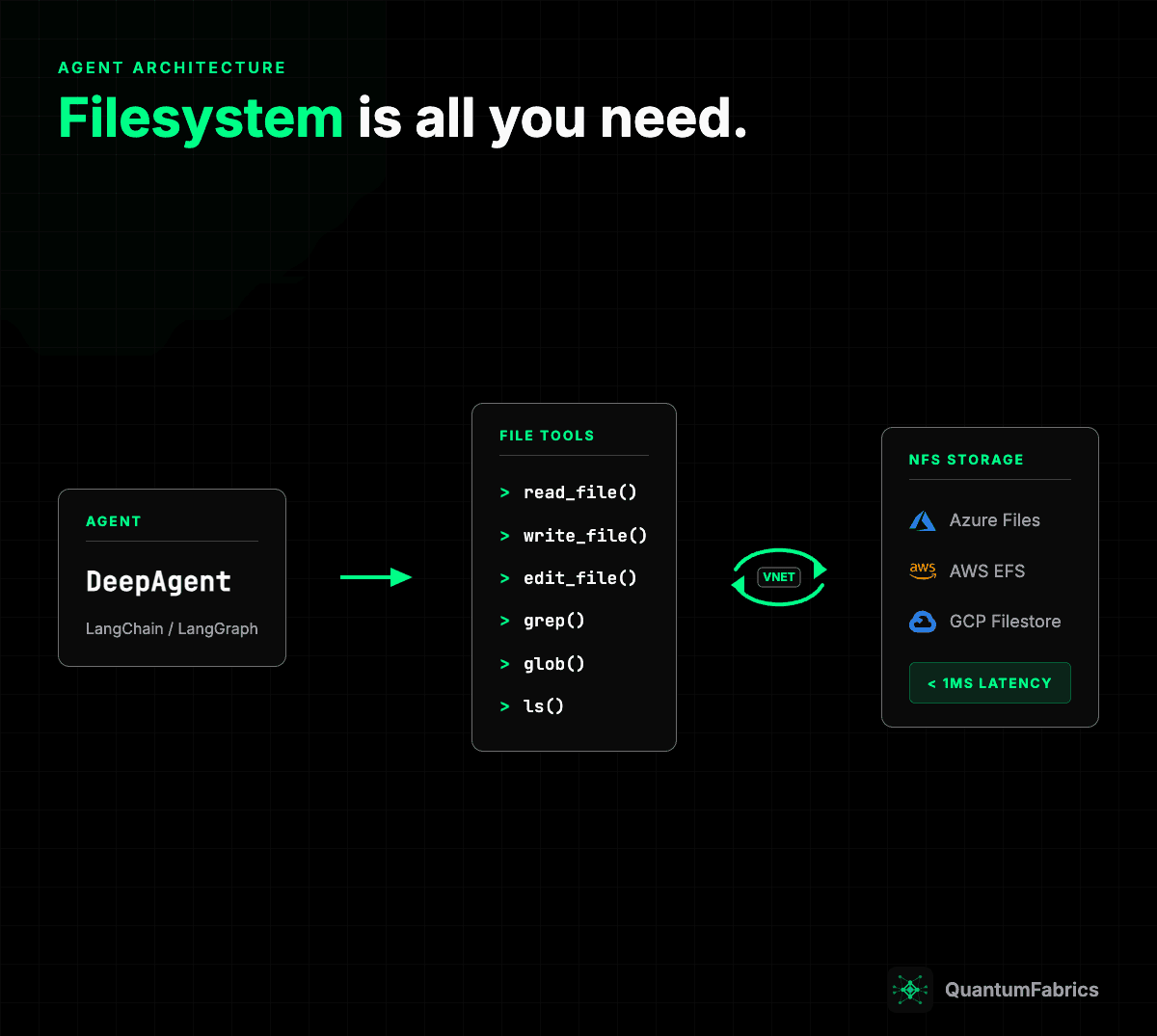
LangChain's DeepAgents framework operationalizes this pattern with a clean abstraction:
from deepagents import Agent
from deepagents.middleware import FilesystemMiddleware

agent = Agent(
    tools=[
        "ls",           # List directory contents
        "read_file",    # Read file content
        "write_file",   # Write to file
        "edit_file",    # Edit specific lines
        "grep",         # Search file contents
        "glob"          # Pattern matching
    ],
    middleware=[
        FilesystemMiddleware(
            auto_save_threshold=20_000,  # Save large results to files
            backend="azure_files"         # Pluggable storage backend
        )
    ]
)
The FilesystemMiddleware automatically saves large tool results (over 20K tokens) to files instead of keeping them in context. This lets agents work with documents far larger than their context window by offloading to the filesystem and reading back what they need.
The backend is pluggable: virtual filesystem for testing, local disk for development, or cloud storage (Azure Files, AWS EFS, GCP Filestore) for production.
Production Setup at QuantumFabrics
We've deployed this pattern across admin workflows at QuantumFabrics:
- HR: Onboarding docs, policy updates, compliance tracking
- Legal: Contract review, clause management, regulatory filings
- Finance: Invoice processing, audit trails, reporting templates
- Operations: SOP maintenance, vendor documentation, process playbooks
Our production stack:
- LangChain DeepAgents with filesystem tools
- Azure Files NFS with VNet integration
- Standard file operations: read, write, grep, glob
The key insight: Azure Files NFS with VNet gives us sub-millisecond latency, compared to ~150ms with blob storage. For agents that make dozens of file operations per task, this adds up fast. The agent maintains its own workspace, searches its past work with grep, and operates with CLI-like speed.
# Agent workspace structure
/workspaces/{agent_id}/
├── context/           # Conversation history, summaries
├── documents/         # Working documents
├── templates/         # Reusable templates
└── outputs/           # Generated artifacts
Each agent gets its own isolated workspace. No cross-contamination between tasks. Full audit trail of every file operation. And because it's just files, existing backup and compliance tools work out of the box.
When to Use This Pattern
Filesystem-based memory works best when:
- Structure matters: Contracts, code, configurations—anything where syntax and structure carry meaning that vectors would lose
- Precision over similarity: When you need exact matches, not "things that mean something similar"
- Audit requirements: Compliance needs clear trails of what changed when
- Large documents: Files that exceed context windows need chunked access, which filesystems handle naturally
- Existing tooling: Backup, versioning, access control—enterprise infrastructure already exists for files
Vector databases still have their place for semantic search across large corpora. But for agent working memory? The filesystem is often enough.
Key Takeaways
- Vector databases optimize for semantic similarity; agents often need exact matching and structure preservation
- Filesystem-based agents score higher on memory benchmarks (74% vs 68.5% on LoCoMo)
- Modern LLMs are already trained on file tools—they know read, write, grep, glob deeply
- NFS mounts (Azure Files, AWS EFS, GCP Filestore) provide sub-ms latency for production workloads
- Sometimes the best architecture is the simplest one
Ready to discuss how AI agents can transform your operations? Get in touch.