The Database Layer Is What Makes AI Agents Enterprise-Grade
Three memory types every production AI agent needs: filesystem, structured SQL, and knowledge graphs. What we learned running an enterprise agent for 6+ months.
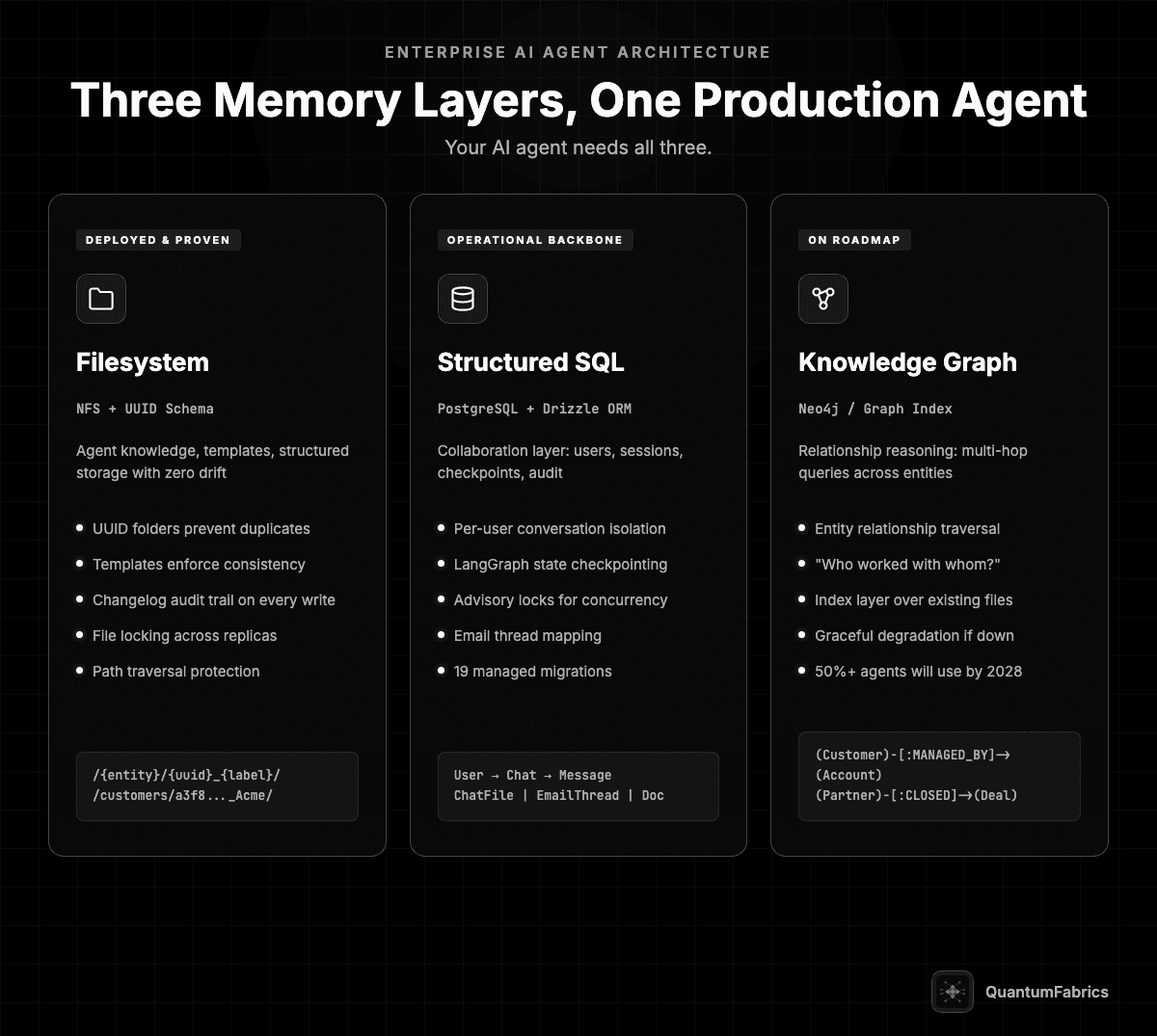
The Database Layer Is What Makes AI Agents Enterprise-Grade
Everyone's talking about which model to use. Which prompt technique is best. Which framework to pick.
Nobody's talking about the part that actually determines whether your AI agent survives contact with enterprise reality: the database layer.
After running an AI agent in production for over six months -- handling real enterprise workflows, real users, real data -- the lesson is clear. The persistence layer is what separates a weekend demo from a production system. It's what enables memory, collaboration, and the kind of usability that makes people actually want to use the thing.
Here's what we learned about the three memory types every enterprise AI agent needs.
1. Filesystem Memory: Proven and Deployed
Our agent stores its working knowledge on NFS (network file storage). Not a vector database. Not a fancy memory framework. Files on a filesystem, organized with a strict schema.
The folder structure follows a simple pattern:
/{entity_type}/{uuid}_{human_readable_label}/
For example:
/customers/a3f8b2c1-..._Acme_Corp/
/projects/7e4d9f0a-..._Q2_Migration/
/accounts/b1c2d3e4-..._Enterprise_Tier/
Every entity gets a UUID generated at creation time. Every folder follows a template. And every file operation -- create, edit, delete -- is logged to a PostgreSQL changelog queue with full context: which user, which conversation, which email triggered it, timestamp, file size, and operation type.
Why This Works
The combination of UUIDs, folder schema, and templates creates what we call "stickiness." The agent doesn't drift. It doesn't invent new organizational schemes on Tuesday that contradict Monday's structure. It finds the existing folder, reads the existing files, and extends them.
This is a bigger deal than it sounds. One of the most common failure modes in production AI agents is organizational drift -- the agent creates duplicate entries, uses inconsistent naming, or loses track of where it put things. Our folder schema eliminates this class of errors entirely.
Enterprise Enhancements That Made It Production-Ready
The raw filesystem alone isn't enough. Here's what we added to make it enterprise-grade:
UUID-based identifiers. Every entity -- customers, projects, accounts -- gets a UUID v4 at creation. This guarantees uniqueness across the system and gives every entity a stable, permanent address.
Changelog logging. Every file operation is intercepted by a logging backend wrapper that enqueues a changelog entry before returning. The changelog captures:
- Operation type (create, edit, delete)
- Full file path
- User email and chat session ID
- Email message ID (for email-triggered operations)
- File size and edit occurrence count
- Timestamp with timezone
This gives you a complete audit trail. When someone asks "who changed this account profile and when?" you have the answer.
File locking across replicas. When you run multiple container instances, concurrent file edits become dangerous. We implemented a two-layer locking mechanism: an in-process promise queue for local coordination, backed by PostgreSQL advisory locks for cross-container mutual exclusion. Default timeout: 30 seconds. This prevents data corruption without adding meaningful latency.
Path traversal protection. Every file path is normalized, checked for directory traversal attempts, and validated against the container boundary before any operation executes. This is table stakes for any system where an AI agent has write access.
Fallback outbox. If the changelog database insert fails after three retries with exponential backoff, the entry is written to a JSONL outbox file on NFS. This survives container restarts and can be replayed later. No audit entries are silently dropped.
Performance
Read latency: 5-10ms. Write latency: 10-20ms. Edit latency: 10-50ms. Compare that to blob storage at 150-300ms per operation. The filesystem is fast enough that agents don't need a caching layer, which eliminates an entire class of cache invalidation bugs.
2. Structured SQL: The Operational Backbone
PostgreSQL handles everything the filesystem shouldn't: structured relationships, transactional guarantees, and multi-user state management.
Our schema (managed with Drizzle ORM across 19 migrations) covers:
Conversation management. Every chat session is stored with user isolation, timestamps, visibility controls (public/private), and a JSONB field for application context. Indexed on (userId, updatedAt) for fast per-user history queries.
Message persistence. Messages use a multimodal parts architecture -- text, images, files, and attachments stored as JSON. This handles the reality that enterprise conversations involve documents, not just text.
LangGraph checkpointing. Agent state is checkpointed to PostgreSQL after every graph node execution. This enables recovery from failures and human-in-the-loop interrupts. Configuration: 7-day retention, 100 checkpoints per thread, connection pool of 50.
Email thread mapping. For email-driven workflows, a dedicated table maps Microsoft Graph conversation IDs to chat sessions, enabling the agent to maintain context across email and chat channels.
File metadata tracking. When documents are extracted (via Gemini, Claude, or Azure), metadata is stored in PostgreSQL: filename, source URL, extracted content URL, token estimates, page counts, and extraction method. This enables multi-turn document access without re-extraction.
Why SQL Matters for Enterprise
This is your collaboration layer. The filesystem stores what the agent knows. SQL stores who's using the agent, what they've discussed, what permissions they have, and how the agent should recover when things go wrong.
Without this layer, you have a single-user tool. With it, you have a multi-user platform with audit trails, session isolation, and operational resilience. That's the difference between "works on my laptop" and "deployed to a team of 50."
3. Knowledge Graphs: The Missing Piece
This is where most teams haven't arrived yet. We haven't either -- it's on our roadmap but not in production.
Knowledge graphs answer a category of questions that filesystems and SQL databases simply can't handle efficiently:
- "Which customers previously worked with the same account manager?"
- "Which partners have contributed to the most successful deals?"
- "What's the relationship between this vendor and these three projects?"
These are multi-hop relationship queries. You can answer them with SQL joins or by having the agent read through files, but it's slow, token-expensive, and fragile.
The Industry Is Moving Here
Gartner predicts over 50% of AI agent systems will rely on context graphs by 2028. Microsoft's Agent Framework v1.0 (released April 2026) formally includes a Neo4j Memory Provider as a core component, with three memory types: short-term (conversation), long-term (entity knowledge graph), and reasoning memory (decision traces).
Neo4j's POLE+O model (Person, Object, Location, Event, Organization) provides a structured approach to entity modeling that maps well to enterprise domains. Companies like Quollio Technologies are already using knowledge graphs for enterprise data lineage, and Syntes AI is building digital twin platforms that ingest from Snowflake and Shopify into Neo4j.
Our Plan
Knowledge graphs will serve as an index layer over our existing NFS files. The filesystem remains the source of truth. The graph provides a queryable relationship index, built incrementally through our existing changelog pipeline. If the graph goes down, the system degrades gracefully to file-based queries.
This matters: don't rip and replace. Layer the graph on top of what's already working.
Your AI Agent Needs All Three
Each memory type serves a distinct purpose:
| Layer | Purpose | What It Enables |
|---|---|---|
| Filesystem | Fast, structured knowledge storage | Agent memory, templates, stickiness |
| SQL | Operational state and collaboration | Multi-user, checkpointing, audit trails |
| Knowledge Graph | Relationship reasoning | Multi-hop queries, entity connections |
Skip the filesystem and your agent has no persistent knowledge. Skip SQL and you have no collaboration, no recovery, no audit trail. Skip the knowledge graph and your agent can't reason about relationships between entities.
The Numbers Tell the Story
The industry data is consistent: persistence is the bottleneck, not the model.
- 86% of enterprises need tech stack upgrades to deploy AI agents (G2, 2025)
- 40-80% of multi-agent implementations fail due to coordination and memory issues (MongoDB research)
- 40% of agentic AI projects will fail by 2027 because legacy systems can't support modern AI execution (Gartner)
- 48% of enterprise leaders cite data searchability as a top challenge (Deloitte, 2025)
- Only 11% of enterprises are actively using AI agents in production (Deloitte, 2025)
The gap between "11% in production" and "40% of apps will have agents by end of 2026" is a persistence gap. The teams that close it will be the ones that invested in their database layer early.
Start With What Works
If you're building an enterprise AI agent today, here's the practical sequence:
-
Start with filesystem memory. Implement a strict folder schema with UUIDs and templates. Add changelog logging from day one. This is the fastest path to an agent that doesn't drift.
-
Add PostgreSQL for operational state. Conversation history, user management, checkpointing. Use an ORM with migrations (we use Drizzle). This is your collaboration foundation.
-
Plan for knowledge graphs. You don't need Neo4j on day one. But design your data model so that entity relationships are extractable when you're ready. The changelog pipeline we built for audit logging will become our graph ingestion pipeline.
The model will get better on its own. Your persistence layer won't build itself.