Three AI Architectures, Three Business Outcomes
Chatbots answer, workflows execute, DeepAgents run. How to choose the right AI architecture for your business needs.
Three AI Architectures, Three Business Outcomes
Most teams pick the wrong AI architecture. Not because they lack technical skill, but because they treat it as a technical decision when it's actually a business one.
The Three Patterns
Every AI implementation falls into one of three architectural patterns. Each serves different needs, and the differences matter.
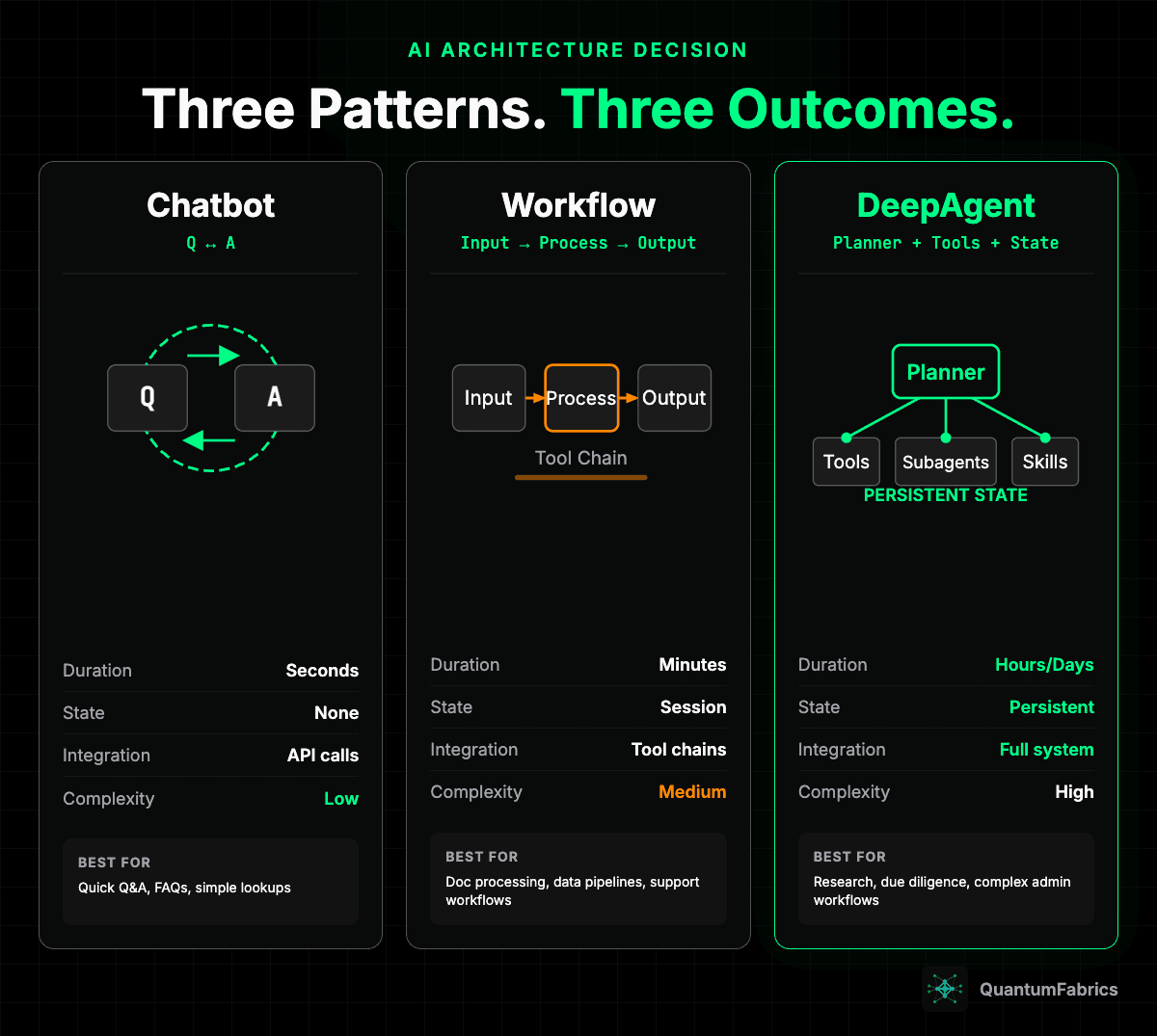
Chatbots: The Q&A Loop
Pattern: Question in, answer out, repeat.
Chatbots excel at quick lookups, FAQ responses, and simple data retrieval. They're stateless by design—each interaction starts fresh.
Best for:
- Customer support FAQs
- Quick data lookups
- Simple information retrieval
Limitations: No memory between sessions. No ability to perform multi-step tasks. No persistence.
Setup cost is minimal. Response time is fast. But capabilities are limited to what can be answered in a single exchange.
Agentic Workflows: The Pipeline
Pattern: Input → Process → Output
Workflows chain tools together in sequence. They're excellent for predictable, linear tasks where each step feeds the next.
Best for:
- Document processing pipelines
- Data transformation and validation
- Report generation from structured inputs
Limitations: Rigid execution paths. Session-bound state only. When requirements change mid-process, workflows break.
More capable than chatbots, but still constrained to predefined sequences.
DeepAgents: The Planner
Pattern: Planner coordinating tools, subagents, and filesystem.
DeepAgents plan before they act. They break complex work into subtasks, execute in parallel when possible, and maintain persistent state across sessions.
Best for:
- Research projects spanning days or weeks
- Due diligence processes
- Multi-step administrative workflows
- Any task requiring planning and adaptation
Limitations: Higher setup complexity. Requires more infrastructure. Overkill for simple tasks.
The tradeoff is capability for complexity. DeepAgents handle work that chatbots and workflows simply cannot.
We at QuantumFabrics successfully deployed DeepAgents in production, and they showed great promise for complex, long-running tasks that require planning and adaptation.
The Decision Framework
Choosing the right architecture comes down to three factors:
| Factor | Chatbot | Workflow | DeepAgent |
|---|---|---|---|
| Task duration | Seconds | Minutes | Hours/Days |
| State needed | None | Session | Persistent |
| Integration depth | API calls | Tool chains | Full system access |
Duration determines how much state management you need. A quick answer needs no state. A multi-day research project needs persistent storage.
State requirements determine whether you need session memory or durable storage. Workflows can hold state during execution, but lose it when done. DeepAgents write to filesystems and databases.
Integration depth determines how many systems the AI needs to access. Chatbots make API calls. Workflows chain tools. DeepAgents need broad access to accomplish complex objectives.
Where Teams Go Wrong
The most common mistake: defaulting to chatbots because they're easy to deploy.
Teams build a chatbot, connect it to their knowledge base, and expect it to handle complex workflows. When it fails, they blame the model or the prompts.
The problem isn't the AI. It's the architecture.
A chatbot cannot:
- Run a due diligence process requiring document analysis, web research, and report synthesis
- Manage a multi-step onboarding workflow with approvals and follow-ups
- Conduct research that spans multiple sessions and sources
These tasks require planning, persistent state, and coordination—DeepAgent territory.
Conversely, deploying a DeepAgent to answer "what's our refund policy?" is engineering overhead for no benefit.
Practical Takeaways
-
Audit your use cases by duration. If tasks complete in seconds, chatbots work. Minutes with clear steps, use workflows. Hours or days with planning needed, consider DeepAgents.
-
Evaluate state requirements. Does the work need to persist between sessions? Does it need to survive restarts? Persistent state demands different architecture.
-
Map integration depth. Count the systems involved. More systems, deeper integration, more capable architecture needed.
-
Start simple, upgrade when needed. Begin with the simplest architecture that meets requirements. Upgrade when you hit limitations, not before.
Conclusion
AI architecture is a business decision disguised as a technical one. The right choice depends on what the work actually requires—not what's easiest to deploy.
Chatbots answer. Workflows execute. DeepAgents run.
Match the architecture to the work.
Sources: